Introduction
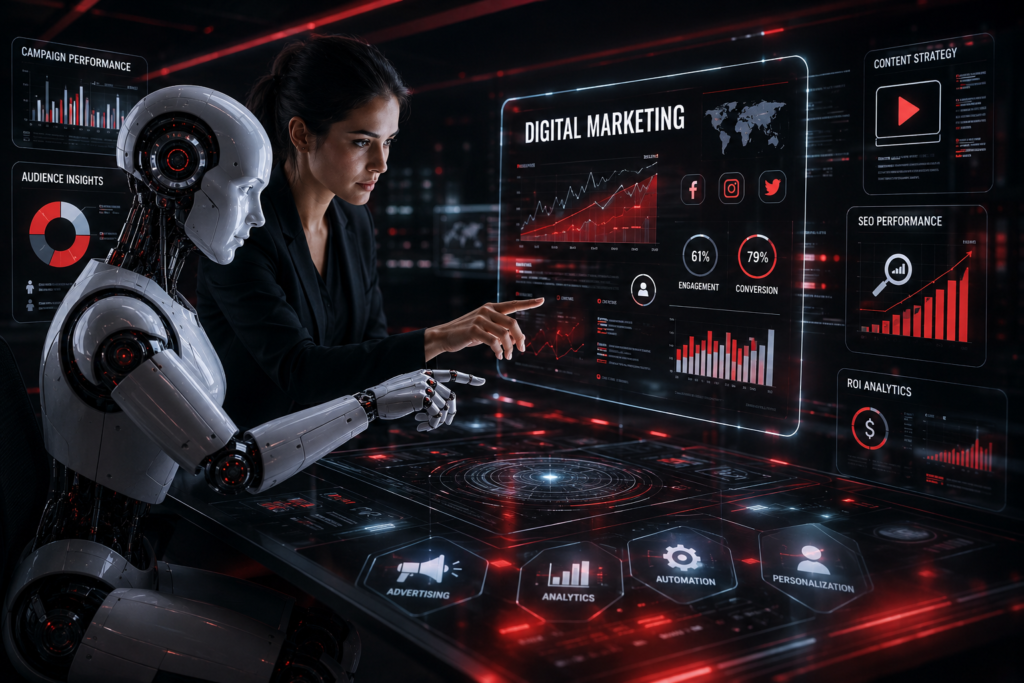
As a beginner digital marketer with two years of experience in content creation, SEO, and social media management, I’ve had the opportunity to closely observe how rapidly the digital marketing landscape is evolving. What once relied heavily on manual effort and creativity has now transformed into a highly intelligent, data-driven ecosystem powered by Artificial Intelligence (AI).
In 2026, AI is not just a supporting tool — it is a core component of marketing strategies across industries. Businesses are increasingly depending on AI to understand consumer behavior, predict trends, automate campaigns, and deliver personalized experiences. However, through my own experience working with multiple tools and platforms, I have realized that while AI enhances efficiency, it is human creativity and strategic thinking that truly drive impactful marketing.
The Role of AI in Modern Marketing
AI has significantly changed how marketers operate. Today, AI tools can analyze large volumes of data in seconds, identify patterns, and provide actionable insights that would take humans days or even weeks to process.
Key capabilities of AI in marketing include:
Predictive analytics for customer behavior
Automated content generation
Chatbots and customer interaction systems
Real-time ad optimization
Personalized recommendations
From my experience, using AI tools has helped streamline workflows and improve productivity. Tasks like keyword research, content suggestions, and performance tracking have become much faster and more efficient.
Why Human Strategy Still Matters
Despite all the advancements in AI, one limitation remains — AI lacks emotional intelligence and human understanding. It cannot fully grasp cultural context, audience emotions, or brand storytelling the way a human can.
In my own content creation work, I’ve noticed that AI-generated content often feels structured but lacks depth. When I edit and refine it by adding real insights and emotional connection, the engagement improves significantly.
This clearly shows that:
- AI supports execution
- Humans create emotional connection
- AI analyzes data
- Humans interpret meaning
 Impact on SEO and Content Creation
SEO in 2026 has evolved beyond keywords. Search engines now prioritize:
User intent
Content quality
Engagement metrics
Relevance and usefulness
This means marketers must focus on creating value-driven content rather than just optimizing for search engines.
From my perspective, combining AI insights with human understanding is the most effective approach. AI can guide what to create, but humans decide how to create it meaningfully.
🔮 Future of AI in Marketing
Looking ahead, AI will continue to grow and become more advanced. However, the demand for skilled marketers will not decrease — instead, it will increase.
Future marketers will need to:
- Understand AI tools
- Interpret data strategically
- Maintain creativity and originality
- Focus on storytelling and brand voice
💡 My Perspective
From my journey so far, I strongly believe that AI is not here to replace marketers. Instead, it is pushing us to evolve and become better professionals.
The real success in 2026 marketing lies in balancing:
- Technology + Creativity
- Automation + Human touch
- Data + Emotion